
New open-access publication: 3D-printed moulds that cool better and use far less metal
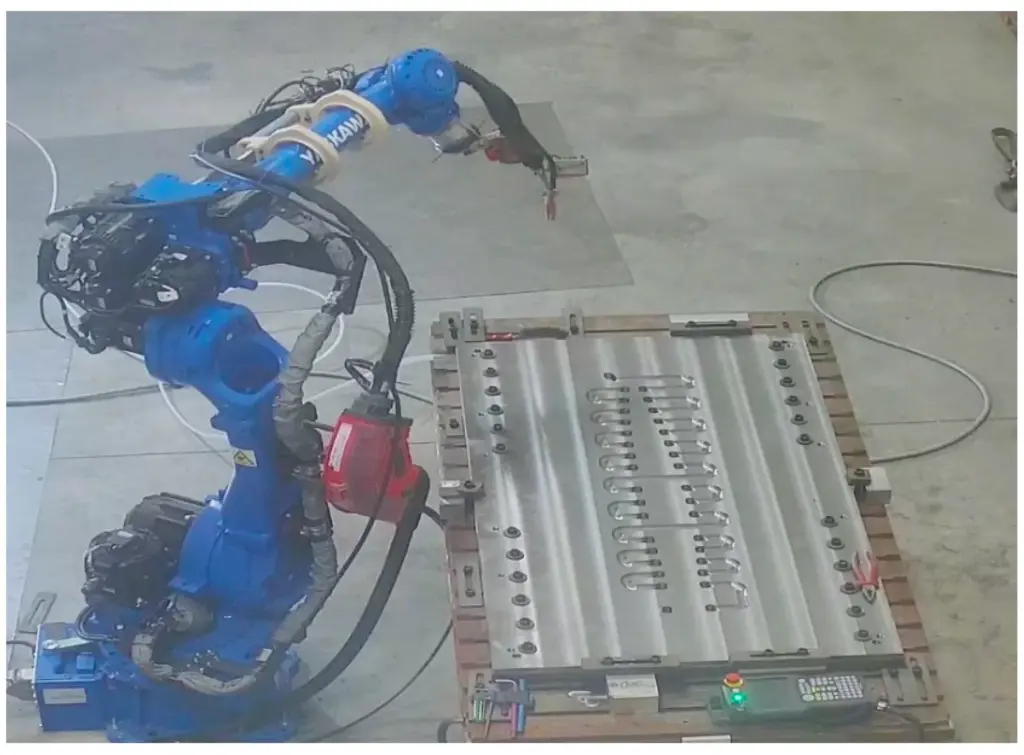
A COMPASS-funded study by our partner AITIIP and the University of Zaragoza has been published in the journal Polymers (MDPI).
The paper looks at how injection moulds can be built with Wire Arc Additive Manufacturing (WAAM), a process that deposits metal layer by layer, instead of machining them from a solid block. Because the mould is built up rather than cut away, its cooling channels can follow the shape of the final part, an approach known as conformal cooling.
The team designed and compared two versions of the same mould, one conventional and one made by WAAM. The main findings:
- Less material. Building the WAAM mould took about 920 kg of metal, roughly 4.1 tonnes less than its conventional counterpart. doi
- Less waste. Its buy-to-fly ratio came to 1.27, against 6.38 for conventional manufacturing. doi
- Better cooling. Simulations credit the conformal channels with almost 19% more heat extraction over the same period. doi
- Better parts. Temperature across the moulded part was also more even, which limits deformation once the part is ejected. unizar
These results support the COMPASS ambition of a more resource-efficient manufacturing industry, where less raw material is consumed to make high-quality components.
Read the full article (open access): https://www.mdpi.com/2073-4360/16/21/3057
Marqués, A.; Dieste, J.A.; Monzón, I.; Laguía, A.; Gracia, P.; Javierre, C.; Clavería, I.; Elduque, D. Improvements in Injection Moulds Cooling and Manufacturing Efficiency Achieved by Wire Arc Additive Manufacturing Using Conformal Cooling Concept. Polymers 2024, 16(21), 3057. https://doi.org/10.3390/polym16213057