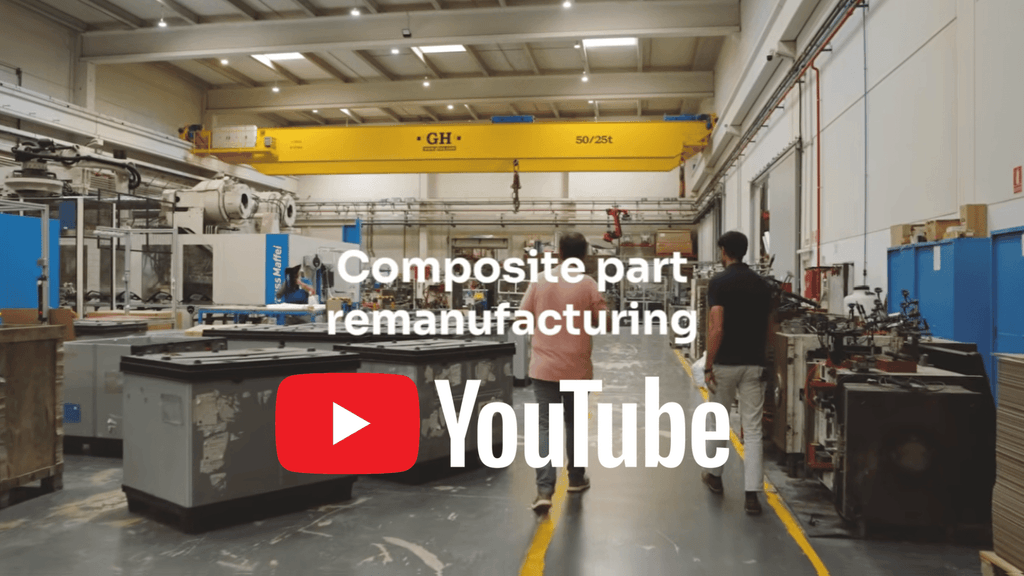
A second life for composites: how COMPASS reshapes end-of-life aircraft parts | Demo video #2
This video follows a thermoplastic composite part from the end of its first life to a new component: flattened, reshaped by thermoforming and supported at every step by data.
Most composite parts from the aerospace and automotive industries still end up in landfill when they reach the end of their life. The reason is simple: efficient and economically viable ways to recover them are missing. COMPASS wants to keep these parts out of the landfill and give them a second life through remanufacturing.
The project’s new video shows how. Partners from across the composites value chain explain the problem, the tools they have built and the forming process that turns a used aircraft part into a new one.
Why composites are so hard to recover
In aerospace, quality control is strict, in production as well as in maintenance, repair and overhaul. Parts that do not meet the requirements are scrapped, and many of them go to landfill.
The material is a large part of the problem. Most composite components today are made with epoxy matrices, which cannot currently be recycled in an economically viable way. This is a challenge shared across the whole composites industry.
COMPASS takes a different route and focuses on thermoplastic composites. These materials can be heated and formed again, so a part can be reshaped without going through energy-intensive recycling steps. The result is a more environmentally friendly process that keeps the value of the carbon fibre and of the work already done.
Two things you need: the geometry and the data
Remanufacturing a part requires two kinds of information. The first is the geometry of the original part that will be reshaped. The second is the data related to it: how it was made, which defects it has, how it was repaired.
In COMPASS this information travels with the component in its Digital Product Passport (DPP). Through the collaboration between partners, the passport also supports life cycle assessment calculations, so that the environmental benefit of a second life can be measured.
Quality data collected automatically
A sensor-based machine vision system provides quality control information automatically during the manufacturing process. It detects the orientation of the carbon fibres and defects on the surface of the part with high sensitivity, and gives feedback to the manufacturing process itself.
A repair assistant developed in the project completes the picture. Together, these tools feed the DPP throughout the life of the component, so the information needed at the end of life is already there.
A process planner for composites
One of the project’s innovations is a remanufacturing process planner adapted to the specific requirements of composite components and their material properties. It takes into account material-specific parameters and the details of the layup. It identifies the regions of an end-of-life part that are suitable for reuse and supports the placement of new components within them.
The aim is to improve material utilisation and process consistency, and to contribute to a scalable, data-driven remanufacturing workflow for composite applications.
From a curved aircraft part to a new component
The video then moves to the shop floor. The demonstration uses thermoplastic composite components that have flown on aircraft and reached the end of their first life. They now provide the material for new components.
Most of these parts are curved, so they cannot be formed again directly. The partners developed a thermoforming approach in three steps:
- Flattening. The sections of the end-of-life component identified in the planning phase are flattened in a dedicated tool designed in the project.
- Heating. A kitting frame holds the flattened plates in an infrared lamp system, which heats the preforms.
- Thermoforming. The plates are consolidated and formed into new geometries with a thermo-mechanical process.
The result is a new part made from material that would otherwise have been waste.
Watch the video
The video is available on the COMPASS YouTube channel: https://youtu.be/de98rduYpIA?si=ChFT7_rgo7ZSJUan