
From Thermal Curves to Mechanical Properties: AI unlocks new possibilities for Aluminium Alloy Characterisation
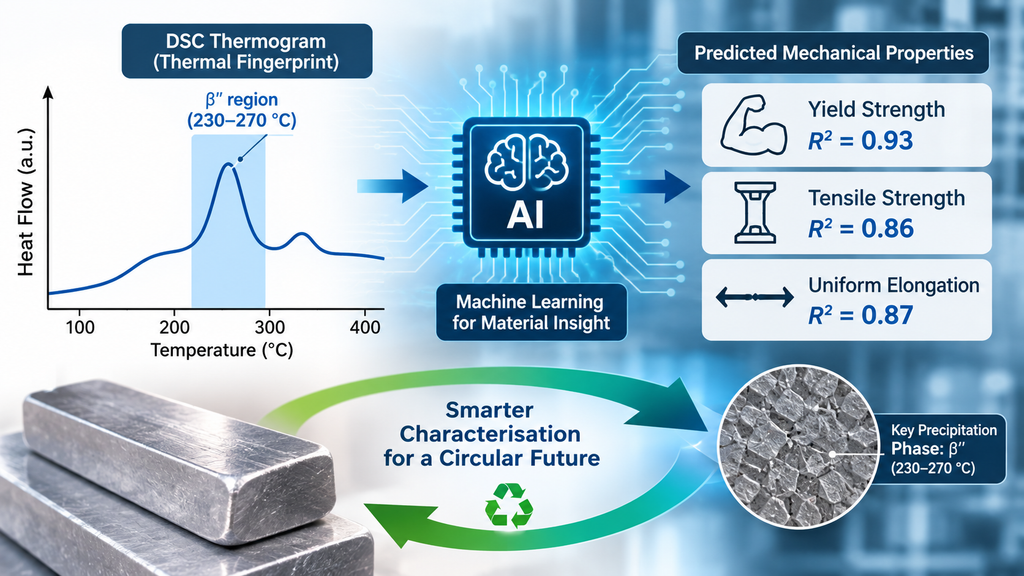
What if a simple thermal analysis could reveal the mechanical properties of an aluminium alloy? New research from AIT Austrian Institute of Technology demonstrates how machine learning can turn Differential Scanning Calorimetry (DSC) curves into reliable fingerprints of material performance.
Understanding the mechanical properties of materials is essential for developing efficient manufacturing processes and ensuring the quality and reliability of industrial components. Traditionally, determining properties such as yield strength, tensile strength and elongation requires mechanical testing, which can be time-consuming and resource-intensive.
A new study entitled “DSC curve fingerprints directly encode mechanical properties of aluminum alloys” explores an innovative alternative: using thermal analysis combined with machine learning to predict the mechanical behaviour of aluminium alloys.
The researchers investigated four representative 6xxx-series aluminium alloys (Al–Mg–Si) subjected to different natural and artificial ageing conditions. By combining Differential Scanning Calorimetry (DSC) measurements with tensile test results, they trained machine learning models to identify relationships between thermal signatures and mechanical properties.
The results are promising. The best-performing model achieved prediction accuracy values (R²) of 0.93 for yield strength, 0.86 for ultimate tensile strength and 0.87 for uniform elongation. Interestingly, the study found that using the complete DSC thermogram provided better results than relying on selected, manually engineered features.
The analysis also identified the temperature range between 230 and 270 °C, associated with the precipitation of the β′′ hardening phase, as particularly important for predicting mechanical performance. Furthermore, the researchers demonstrated that prediction accuracy for a previously unseen alloy could be significantly improved by including only one or two reference conditions from that alloy.
Why is this relevant to COMPASS?
The findings offer an interesting perspective for the development of data-driven manufacturing and remanufacturing processes, which are at the heart of the European COMPASS project.
In remanufacturing, understanding the condition and properties of materials is crucial to deciding how components can be processed, restored and reused. Advanced characterisation methods, combined with artificial intelligence, can help make these decisions faster and more efficiently.
The approach presented in this study demonstrates how thermal measurements can be transformed into valuable material information, potentially reducing reliance on conventional mechanical testing during alloy screening and process optimisation.
More broadly, it highlights the potential of combining experimental data, material science and machine learning to support smarter, more resource-efficient manufacturing.
Towards more intelligent material characterisation: by turning thermal curves into meaningful mechanical property predictions, this research contributes to the broader vision of digital, data-driven and circular manufacturing.
Publication: DSC curve fingerprints directly encode mechanical properties of aluminum alloys.